
Our Neighbors
Of all the buildings on our property, my favorite may be the garage.
Which surprises me a little. And if you know me, it probably surprises you even more. I am not really a garage kind of guy. I know people and numbers. That’s it.
When I think about it, the house is more comfortable. The caves are certainly more interesting. And the old winery is the reason we bought the place in the first place. Yet I find myself wandering into the garage more than any of them.
It sits just beyond the courtyard. Thick stone walls. Massive oak timbers holding up a roof that has no business still being there.
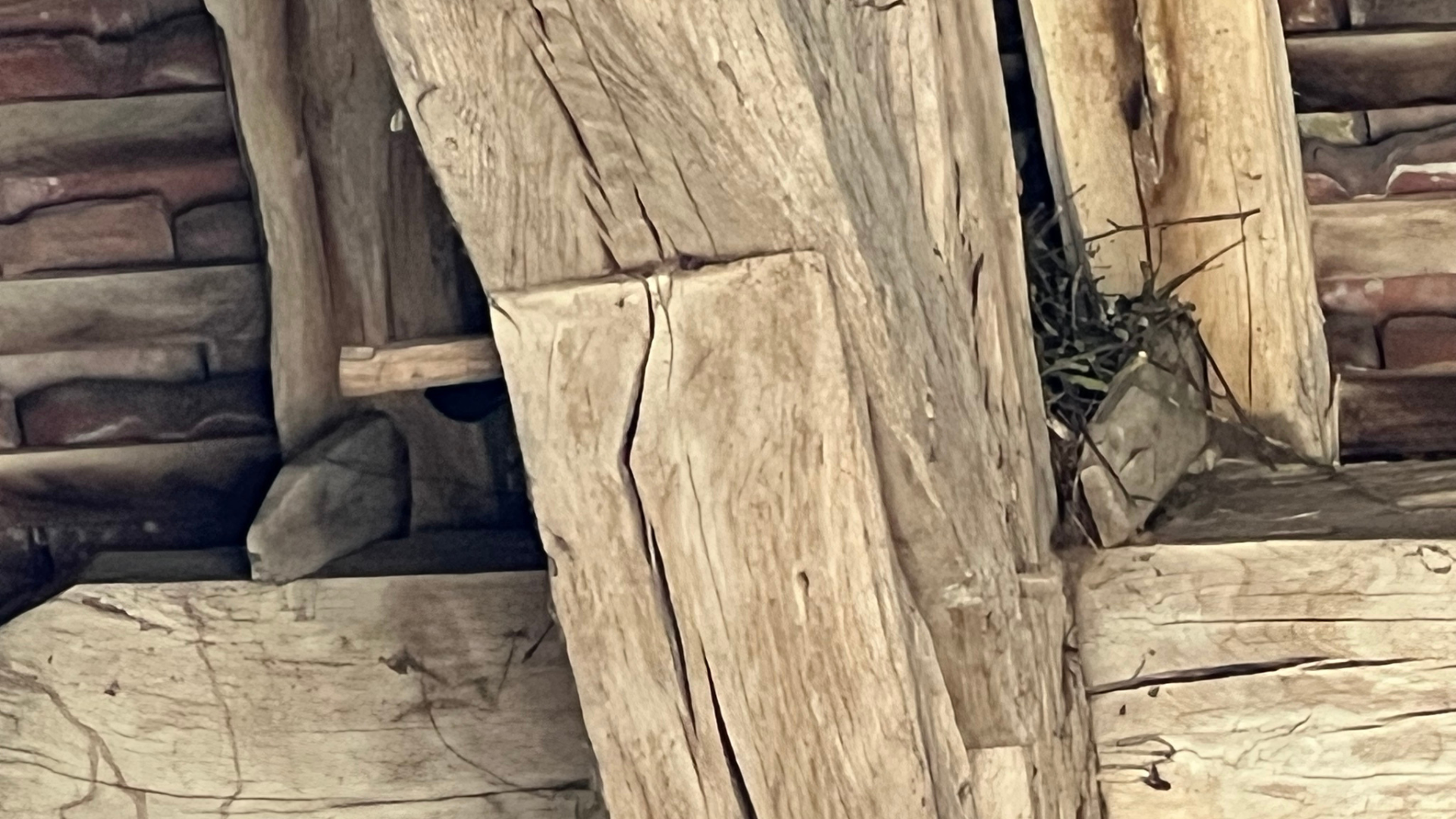
The first thing I noticed were the beams. None of them are perfectly straight. They twist and curve in places, still carrying the shape of the trees they once were. Whoever built the garage didn't force nature into perfect lines. He worked with what he had and took the trees as they came, bends and all, and somehow turned them into a structure that has survived for centuries.
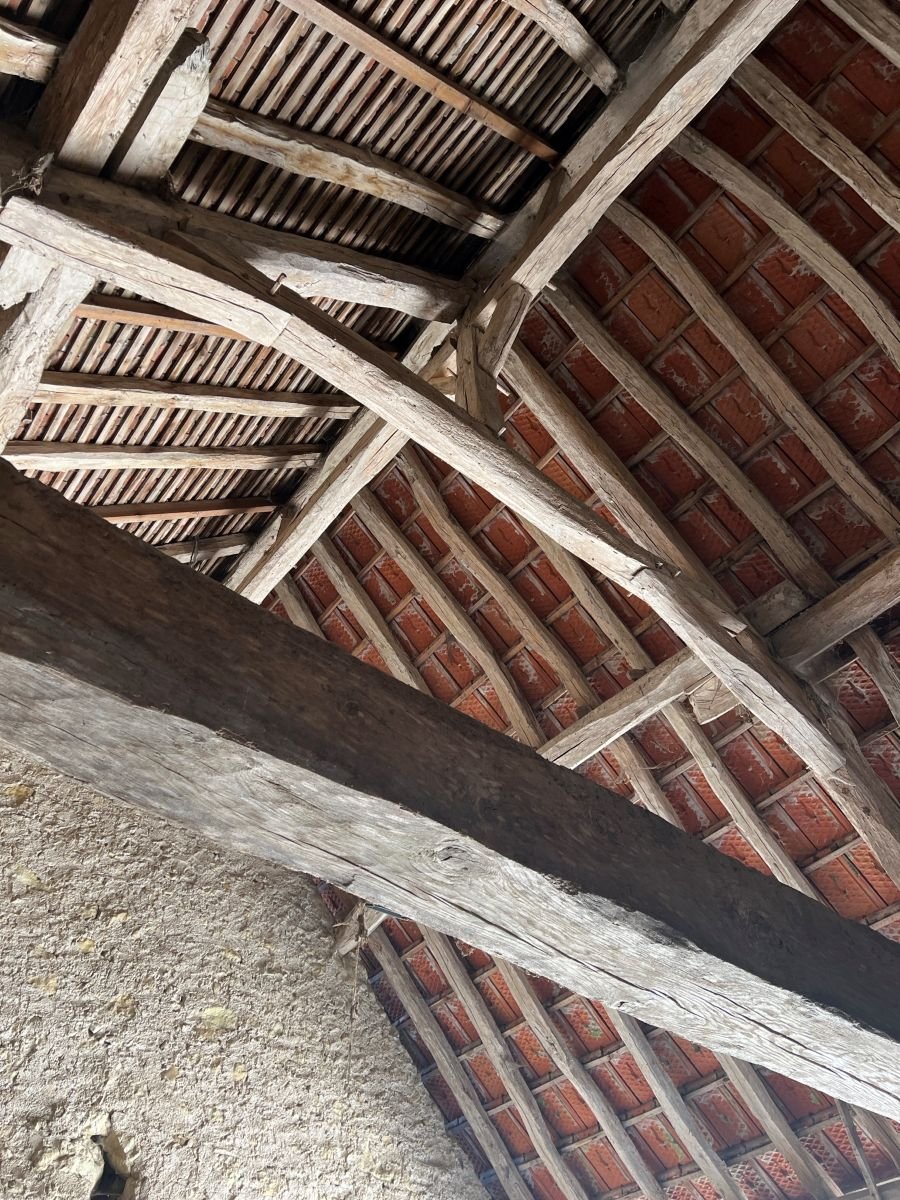
Sometimes I stand inside and look up at the rafters and wonder how many people have done exactly the same thing over the last two hundred years.
But I imagine my thoughts are very different from the men who built it. They understood exactly how it worked. I spent three hours putting two roof racks on top of my SUV and considered that a major accomplishment.
They looked at an oak tree and saw a building. I look at this building and see a renovation budget that could break me. I mostly stand there hoping nothing ever happens to it.
The building has survived revolutions, wars, economic downturns, and generations of French farmers. Today it protects a grill, patio cushions, a bicycle, and several Amazon boxes whose purpose I can no longer remember.
It also provides housing for Fred and Ethel.
I first noticed Fred and Ethel long before they moved into the garage. They were regulars in our yard, usually sitting together on the wire above the road or wandering through the grass looking for something to eat. Unlike the pigeons I grew up seeing in New York, these birds had a certain dignity about them.
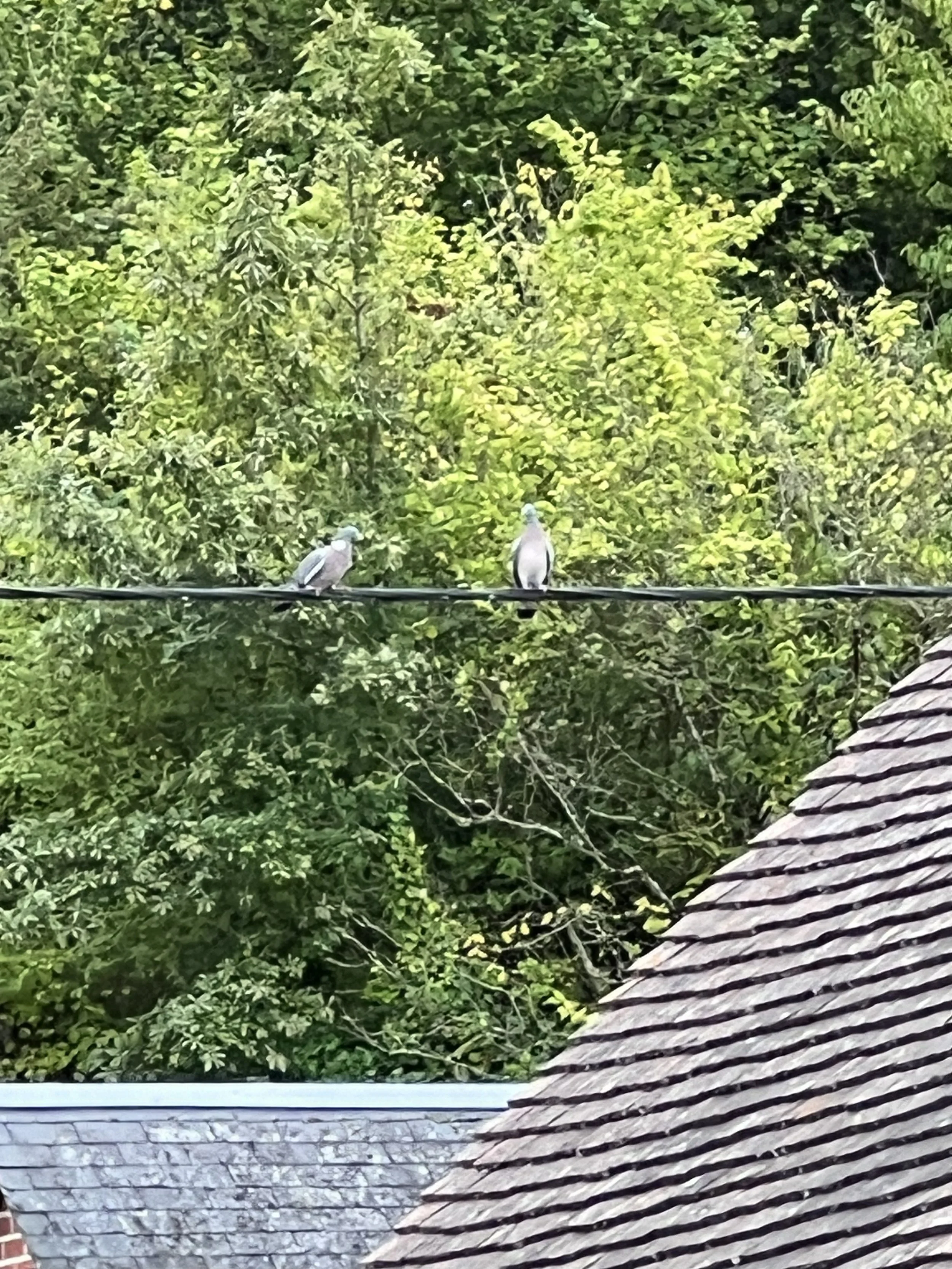
If you spend enough time in the Loire Valley, you get used to hearing wood pigeons. Their low, repetitive cooing is part of the soundtrack around here. Like church bells, tractors in the distance, and French neighbors having conversations that somehow sound like arguments even when they are discussing what cheese to serve with dinner. It is just another sound of country life that you eventually stop noticing.
Until one day you do.
The pigeons I grew up with in New York were not exactly creatures of mystery and romance. They lived on sidewalks, fought over discarded food, and generally carried themselves like birds who had made a series of bad life choices.
I am not a bird guy. I couldn't have told you the difference between a wood pigeon and any other pigeon if my life depended on it.
Fred and Ethel were different.
They lived among vineyards. They walked around the property as if they owned it. And with their gray feathers, soft pink chests, and neat little white collars around their necks, they looked like they had dressed for dinner. But their greatest charm was in their permanent expressions of mild confusion.
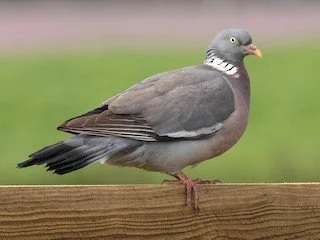
Wood pigeons mate for life. After watching Fred and Ethel for a while, I could tell. They had developed the same communication style as every couple that has been together for decades. They were always together, always talking, and occasionally one of them was clearly doing more of the talking. Most afternoons, Ethel could be heard explaining something to Fred with great conviction. What she was explaining remained unclear. What was obvious was that Fred had no interest in arguing.
Of course, I was probably wrong about all of it. The conversations. The personalities. The entire relationship dynamic. They were birds.
But it didn't matter.
They had become part of the rhythm of the place. Along with morning coffee, the dogs in the yard, the church bells from the village, Fred and Ethel were up on the wire or perched on the roof of the garage.
The first sign that Fred and Ethel had moved into the garage came when they started objecting to my presence. Apparently, they had a different understanding of the ownership arrangement. I was under the impression that I had purchased the property. They seemed to believe they had inherited it.
Any time I walked in to uncover the grill or retrieve something from storage, one of them would launch from the rafters and swoop low over my head before circling back to safety.
The first time it happened, I ducked. The second time, I ducked again. By the fifth or sixth time, I was standing outside my own garage debating whether I really needed a tool or if the project could wait.
It wasn't until the same thing started happening again this year that I started to connect the dots. Fred had resumed his aerial attacks. This time, instead of ducking and moving on, I stopped and looked up. Way up.
Near the peak of the roof, balanced on the center beam that runs the length of the garage, sat a nest I had somehow never noticed before. I grill in that garage a couple of times a week. How did I miss it?
The discovery explained everything. The dive bombing. The agitation. The suspicious looks. Fred and Ethel weren't trying to evict me. They were trying to protect their family. Suddenly their behavior seemed a lot more reasonable.
Once I discovered the nest, I found myself worrying about something entirely different.
The chicks.
More specifically, what kind of chicks they were likely to become.
There was no way for the smoke from my grill to leave the garage without passing directly by the nest. This meant that any young pigeons raised in that nest would spend the earliest days of their lives marinating in the aroma of whatever happened to be for dinner.
I became concerned that they might emerge with unusually expensive tastes.
Before they even hatched, they had been exposed almost exclusively to New York strip steaks, lamb chops, duck-fat potatoes, rotisserie chickens, Toulouse sausages, and the occasional bottle of Côte du Rhône.
Most birds are introduced to worms and seeds. These birds were effectively being raised above a French steakhouse. I pictured Fred returning to the nest carrying a perfectly respectable earthworm only to be met with disappointment.
"Do you have anything grass-fed?"
The possibilities were troubling. What if they developed preferences? What if they refused ordinary bird food? What if they became the first pigeons in history to send a bottle of wine back because it wasn't breathing properly?
And for the record, if Ethel successfully raised chicks above a grill that regularly produced what we like to eat, those babies were going to leave the nest with standards no ordinary bird feeder could possibly satisfy.
I imagined them leaving home someday and discovering that most pigeons spend their lives eating things they find in parking lots. The adjustment would be difficult.
The first clue appeared a day or two earlier when I saw Viggo walking around the property with something in his mouth that looked suspiciously like part of a bird's nest.
Viggo approaches life with the curiosity of a toddler and the judgment of a toddler who has never been told no. I took it away, gave him a lecture he did not understand, and moved on.
A few days later, after a day when the wind seemed determined to rearrange the Loire Valley, I came home and noticed another pile of sticks sitting in the opening of the garage. At first, I barely looked at it.
My immediate thought was, "What did Viggo get into now?" Then I walked closer. It was the nest.
The thing about living in the countryside is that nature is beautiful right up until it isn't. Over the last two years, Denise has buried three birds in our garden.
One of them flew into the window near the entrance to Cave Two. I didn't see it happen. I only discovered the aftermath when I took the dogs outside and watched Viggo sprint toward something on the ground.
The way he pounced on it with both paws, I assumed he had found a squirrel or some other small animal. Then I got closer. It was the bird.
Suddenly I was chasing a very happy Golden Retriever around the yard yelling "Viggo, out!" and "Viggo, leave it!"
Eventually, Viggo surrendered his prize. Denise handled the burial. I provided emotional support and stayed a respectful distance away.
I walked over to Denise's office and broke the news carefully. "I think Fred and Ethel's nest came down." The tone of the conversation probably suggested we were discussing a family emergency. Which, considering we were talking about two birds I had known for less than a year, was probably not entirely rational.
Standing at the entrance to the garage, I found myself wondering what I was about to find. The nest itself wasn’t what worried me. It was what might be underneath it. I wasn’t ready for an unhappy ending.
I took a step forward, scanning the stone floor. My eyes moved from the scattered twigs to the darker corners, half-expecting to see something I didn’t want to see. For a few long seconds I just stood there. Fortunately, there wasn't anything there. At least not the kind I feared.
The nest was down. Fred and Ethel were nowhere to be found. But there were no feathers or anything else that suggested the worst.
I couldn't tell what happened. The wind had been howling all day, and the nest had been sitting fifteen feet in the air on a beam out in the open.
What I could find online suggested that wood pigeons may be the worst nest builders in the bird world. Even bird experts seem to make fun of them for it. Most of the time, their nests consist of about twenty sticks and a prayer.
In other words, the collapse may not have been a tragedy at all. It may simply have been a complete failure of avian engineering.
Fred and Ethel disappeared for a couple of days after the collapse. I don't know where they went. Perhaps they were grieving, or perhaps they were evaluating alternative real estate. Maybe they simply took a few days off to avoid discussing what had happened.
A few days later, I walked into the garage and looked up. There, sticking out from the highest beam, were two pigeon tails sitting side by side. They looked like a pair of high school sweethearts in a pickup truck overlooking a lake.
By this point Viggo had taken quite an interest in what was going on in the garage. Every few seconds Fred would swoop down out of the garage a few feet over Viggo’s head on his way to the forest up above the caves.
At first, I thought Fred and Ethel had learned something from the collapse of the first nest.
They had not.
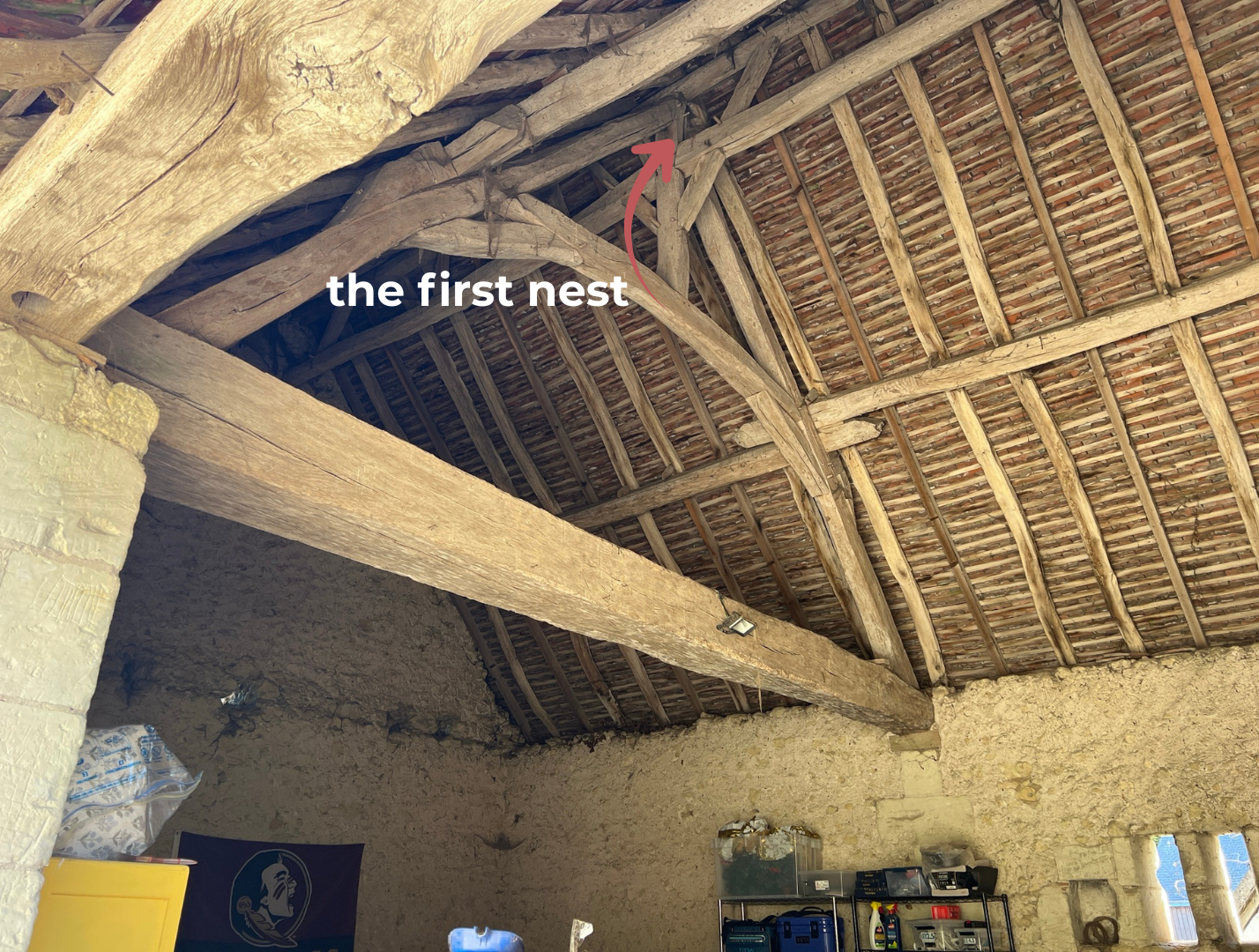
In pigeon relationships, the male typically does most of the stick gathering while the female supervises construction. By "supervises," I mean she moves Fred's twig three inches and somehow takes credit for the project.
Looking at the number of twigs scattered across the garage floor, it became clear that everything I had read about wood pigeons was playing out in real time. Fred had no idea what he was doing. His judgment on stick size was as bad as my father's ability to match a striped shirt with checked pants.
Fred would fly off into the woods and return carrying a stick. Ethel would inspect it. Fred would place it carefully into the nest. A few seconds later, the stick would fall through the floor of the garage.
Then Fred would fly off and get another one.
So now Fred had developed a process:
Fred flies off, grabs a stick.
Ethel sits at the construction site.
Fred returns with a stick.
The stick falls through to the floor.
Repeat 200 times.
This went on most of the day while we were working out in the yard. Once I had to go into the garage for a tool, Fred came down wide eyed straight at me, his usual expression of mild confusion somehow amplified by the fact that he was now flying directly at my face. Neither of us knew which way he was going to cut. I just stood there, Viggo watched, and Fred was headed back up to the woods.
But for some reason, this process inspired remarkable confidence in both of them. Every stick that fell to the floor seemed to have no effect on their belief that the next one would be the one.
The more I watched them, the more I admired them. Not because they were good builders. They were objectively terrible builders. A wood pigeon nest is what happens when confidence significantly exceeds ability.
I watched Fred fly into the garage carrying a branch roughly the size of a canoe paddle. Ethel appeared unconvinced.
"The branch is six feet long."
"I measured it."
"The nest is eight inches across."
"Trust the process."
The more I watched Fred, the more I recognized him. He approached every new challenge with confidence, enthusiasm, and absolutely no evidence that his plan would work.
This morning I went into the garage to check on the reconstruction project. There wasn't much activity. Ethel was sitting in the nest. She stared directly at me. She made a few sounds that, to my ear, translated roughly as: "What?"
What surprised me was the nest itself. It was tucked deeper into the timber frame than the first one had been. Protected on several sides and less exposed to the wind. Not dramatically better, just better. It seemed the collapse had resulted in at least a limited review of construction practices.
Fred was sitting on top of the roof of the garage making his usual announcements. Coo. Coo. Cooooo. Which roughly translates from pigeon into English as: "This vineyard. This garage. These two golden retrievers. All under my protection."
Meanwhile Ethel was doing all of the actual work.
As for what happens next, I have no idea. Maybe this nest survives and maybe it doesn't. Maybe there are eggs tucked away up there right now. Maybe there aren't.
What I do know is that wood pigeons have been building nests this way for a very long time. It doesn't make much sense to me. It doesn't seem like it should work. Yet somehow there are wood pigeons everywhere I look.
Viggo has largely lost interest in the project. I haven't. I just hope I never have to ask Denise to get involved again.