
A Saturday Between Montsoreau and Saumur
It seemed like a perfectly reasonable Saturday plan.
Drive down the Loire to Montsoreau, wander the brocante market along the river, maybe come home with something we absolutely didn’t need but would somehow justify later.
Montsoreau sits where the Loire and the Vienne meet, a small village that looks like it was arranged by someone with a very good eye for stone and water. The château rises straight out of the riverbank. Boats drift past. Vineyards climb the hills behind the town. On paper, it almost feels unfair.
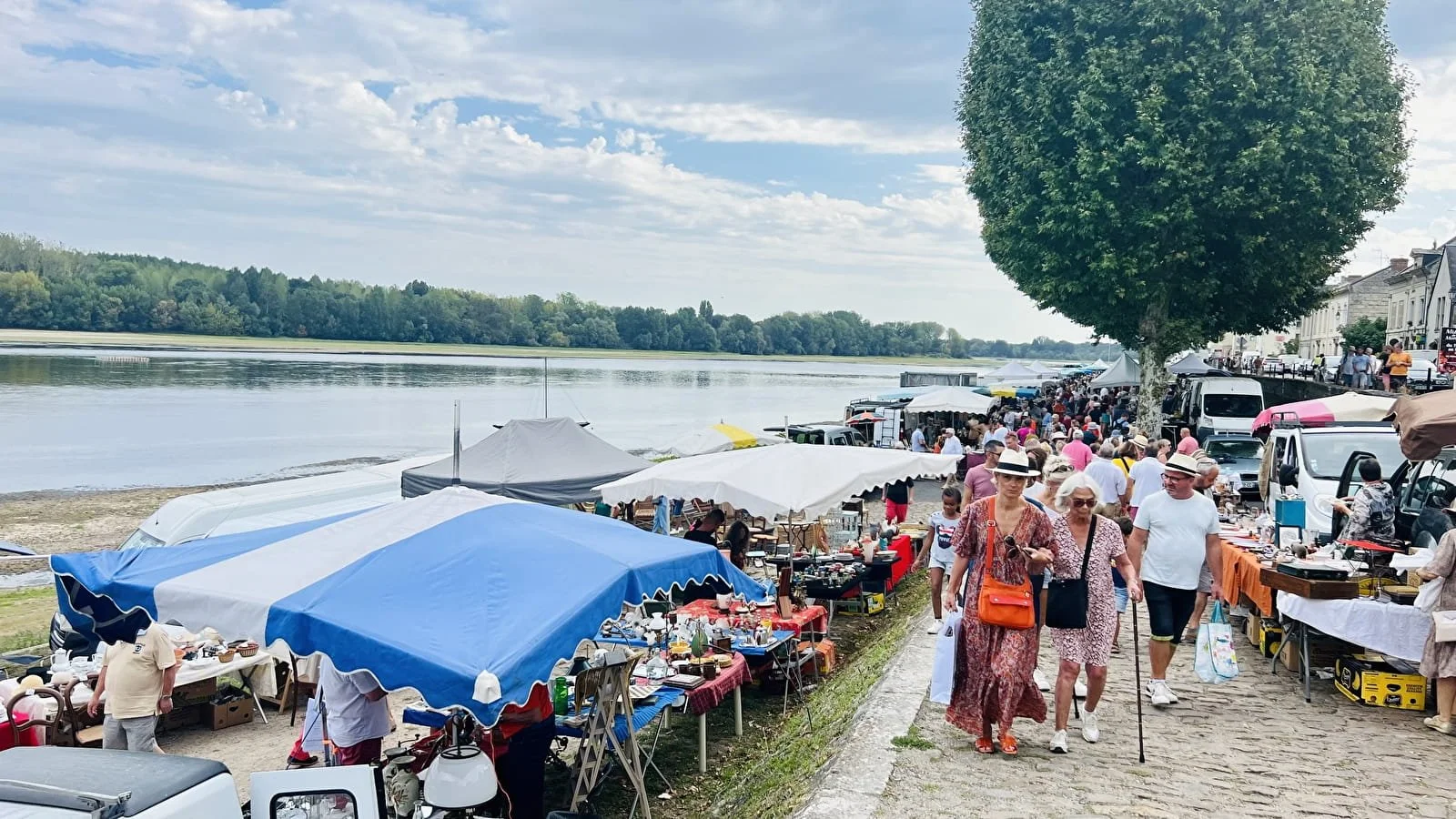
On weekends, the village fills with a brocante market that spills along the river. Tables covered in neatly stacked linens, surrounded by old furniture waiting for a second life. Silverware that has already survived a few generations of dinners. Wooden cabinets that probably came out of farmhouses where nobody ever imagined they would one day be loaded into the back of a modern car.
We arrived early, confident we had beaten the crowds. Parking in Montsoreau that morning had already been something of a negotiation.
The village was full, every street lined with cars belonging to people who had arrived before us. Just as I was beginning to consider abandoning the plan, we stumbled across a makeshift parking area on a grassy rise above town. Someone had clearly decided it was a parking lot for the day. Cars were already scattered across the lawn.
I drove in slowly.
“Over there,” Denise said, pointing confidently to a spot I had already passed.
You know the kind of moment. The woman points to the perfect parking space immediately after the man has driven beyond it.
Instead of attempting an awkward mid-field correction, I backed into a spot along the edge of the lawn. To my left was a culvert, and behind me the ditch curved back toward the road. It looked stable enough. We shut the doors and headed down toward the market feeling rather pleased with ourselves.
Markets like the one in Montsoreau aren’t really about shopping. They’re about circulation. Objects move from one life to another. A linen tablecloth that once sat in someone’s farmhouse kitchen ends up folded under the arm of a stranger who now plans to use it in a completely different house. Cabinets, tools, chairs, silverware. France seems unusually comfortable with this quiet passing of things forward.
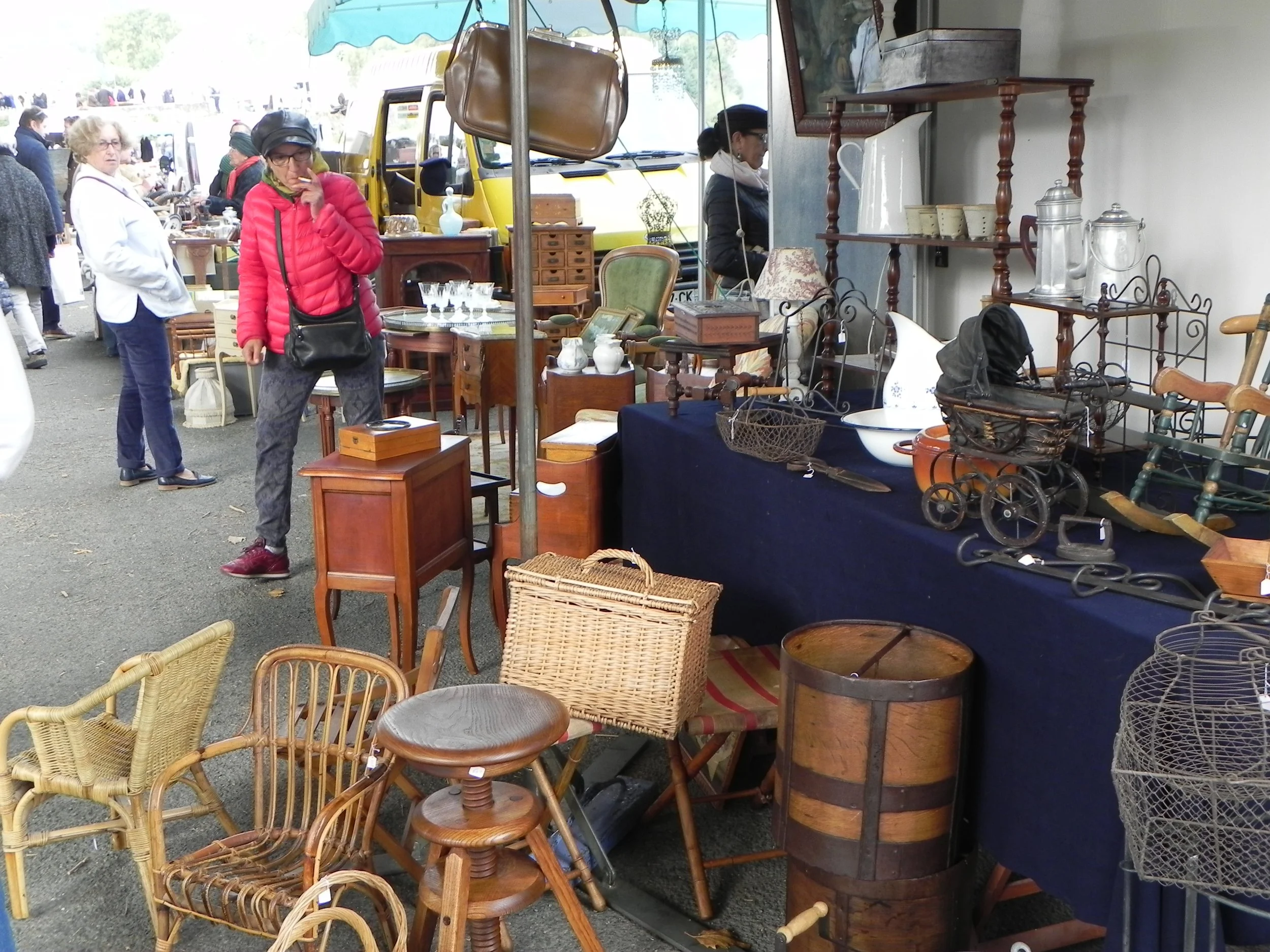
French brocante markets have a different energy than antique markets back home. The objects don’t feel arranged to catch you with a clever display or convince you of their value. They feel like they came straight out of houses that were lived in for a long time. Chairs that have held decades of dinners. Linen that has been washed so many times it feels almost soft enough to disappear in your hands. Nothing is trying to impress you. The past is simply laid out on tables for the next person who wants to live with it.
There’s a patience in that. In France, things tend to last. Houses stand for centuries. Furniture moves through generations. Even a brocante table carries the quiet assumption that whatever sits on it has already lived a long life and might as well keep going a little longer.
Denise approaches a market like this the way a serious collector approaches a hunt.
Within minutes she was elbow-deep in a stack of embroidered linens, the kind that make you wonder how many hands have folded them before yours. Somewhere in the middle of it all she spotted a tall umbrella stand made of dark iron and wood, easily a hundred years old and exactly the kind of object that somehow follows us home from places like this.
I did what I usually do at that point. Sully and I slipped away for a mimosa.
Le P’tit Bar, a small brasserie, sat just off the river, the kind where nobody rushes you and the chairs have been facing the same direction for decades. I took a seat where I could watch the market drift past while Sully settled in at my feet, already drawing the kind of attention a Golden Retriever naturally commands in France. A mimosa in front of me. The Loire moving slowly past the village. Sully accepted the attention with the quiet confidence of someone who has been here before.
I sat there in the cool fall morning air watching the market unfold around us. Families drifted past. Children stared curiously at the strange man sitting alone with his dog. I imagine a few of them were quietly inventing their own explanation for why I was there.
Or maybe they were just wondering why that guy kept pouring champagne from a small bottle into his orange juice.
Meanwhile, Denise continued her expedition somewhere among the tables of linens and furniture, occasionally reappearing long enough to show me another discovery before disappearing back into the hunt.
By the time we made it back to the car, the back of the wagon had been claimed by linens, an umbrella rack, and a few other things we apparently needed. Sully wasn’t thrilled about the new seating arrangement.
The linens were carefully folded. The umbrella rack was wedged into a position that suggested it might or might not survive the drive home. A few other fragile objects had quietly joined the cargo without much discussion.
The field had softened while we were gone.
I started the car and eased forward. The moment I tried to pull out of the parking space, the rear wheels began spinning. Denise gave me that look.
Inside my head a voice had already started shouting the obvious question. Now what?
I stepped out of the car. “I’m going to push,” I said. “You’re going to have to drive.”
Manual transmission, rear wheel drive. Denise behind the wheel. How much mud was I going to be wearing?
I positioned myself behind the car and laid out the plan. “Okay, we’re going to rock it. Pull forward while I push, then let it roll back toward me. We’ll do that a couple times and try to build some momentum.”
The wheels spun. Mud started spraying.
“Ease up.”
“Okay, let it come back.”
The car stopped.
“No, not the brake, D. Push in the clutch.” “Go forward.” Spinning wheels again.
Somewhere in the middle of it Denise started laughing. The kind of laugh that comes when you suddenly realize how ridiculous the situation has become. She could see exactly what she was doing wrong, but that didn’t seem to stop her foot from finding the brake pedal anyway.
“Hold on, hold on… let it come back.” “Not the brake babe.”
“Well there is a culvert there.”
What I would have given in that moment for a scrap of cardboard to wedge under a tire. My mind had already started calculating the next steps. Tow truck. Saturday morning. An hour and a half from home.
Why me?
That’s about the moment the first man wandered over to see what was going on. Then another. Suddenly I had a team.
Within a few minutes I found myself standing behind the car with five French men I had never met before, all of us pushing in unison while Denise tried to decide whether the correct solution involved pressing the gas pedal or standing firmly on the brake.
Opinions were offered. Instructions were shouted. Sully supervised.
Eventually, with a combination of momentum and collective optimism, the car lurched forward just enough to escape the mud.
There was a brief moment of celebration, the kind shared between strangers who had successfully solved a problem that technically didn’t belong to them five minutes earlier.
We shook hands, exchanged a few appreciative nods, and climbed back into the car. By that point most of the field seemed to be watching the Americans. Whether it was amusement or simple curiosity about whether we were actually going to make it out of the parking area remained unclear.
We eased our way out of the field before anyone had the chance to place bets.
We decided to head up to Saumur for lunch.
The Loire was only a few minutes away. The Loire moves differently than most rivers. Wide, pale, and unhurried, it slides through the valley like it has nowhere pressing to be. Sandbanks appear and disappear with the seasons, and the light seems to linger on the water just a little longer than expected.
Saumur reveals itself slowly.
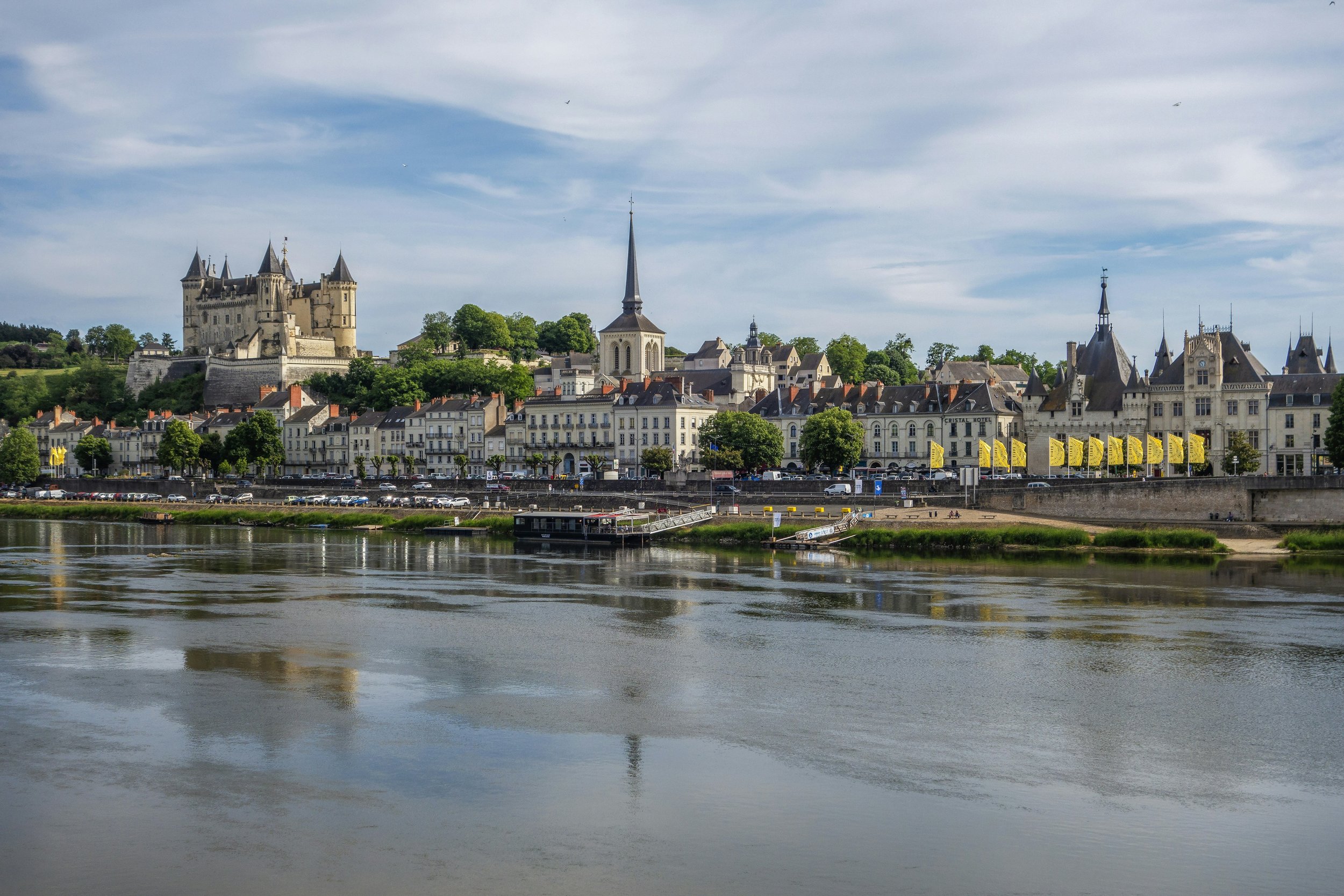
From the river road the Château de Saumur rises above the town like it has been calmly watching the Loire for the better part of a thousand years.
The original fortress was built here in the 10th century to defend against Norman attacks. In the 12th century it was rebuilt by Henry II of England before eventually becoming part of the French crown. Over the centuries the Counts of Blois and the Counts of Anjou reshaped it into the château that dominates the skyline today.
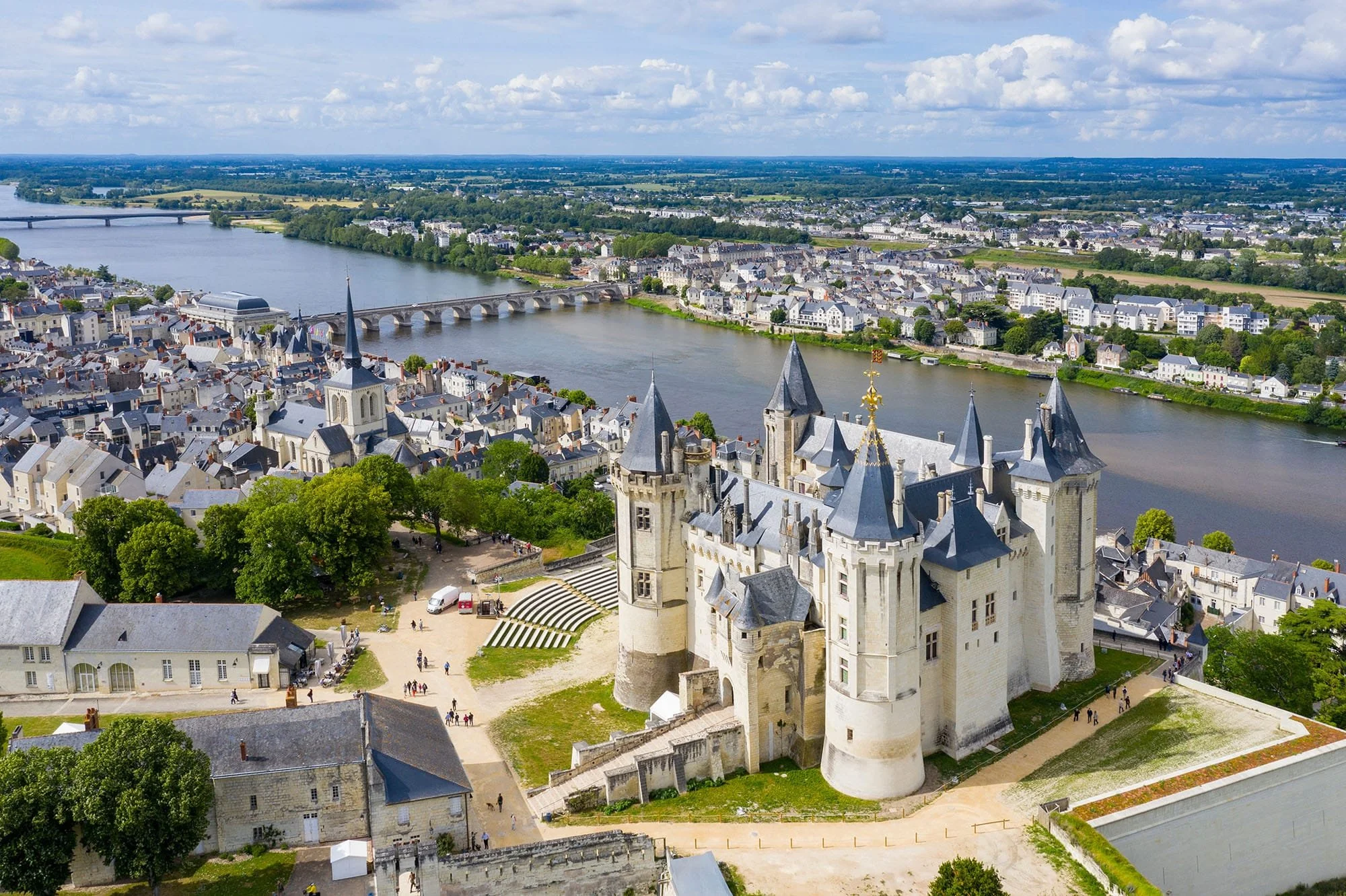
It hasn’t always been a romantic residence. Under Louis XIV and later Napoleon Bonaparte it served as a prison, at one point even holding the notorious Marquis de Sade.
Today it simply watches over the town.
Saumur has always been tied to horses. The famous Cadre Noir is based here, the elite cavalry school that still trains riders in the classical traditions of French horsemanship. Even if you never see the riders themselves, there’s a certain elegance in the town that feels connected to that history.
We parked near the center and stepped out into the cold air, the kind that makes the idea of lunch feel less like a convenience and more like a necessity.
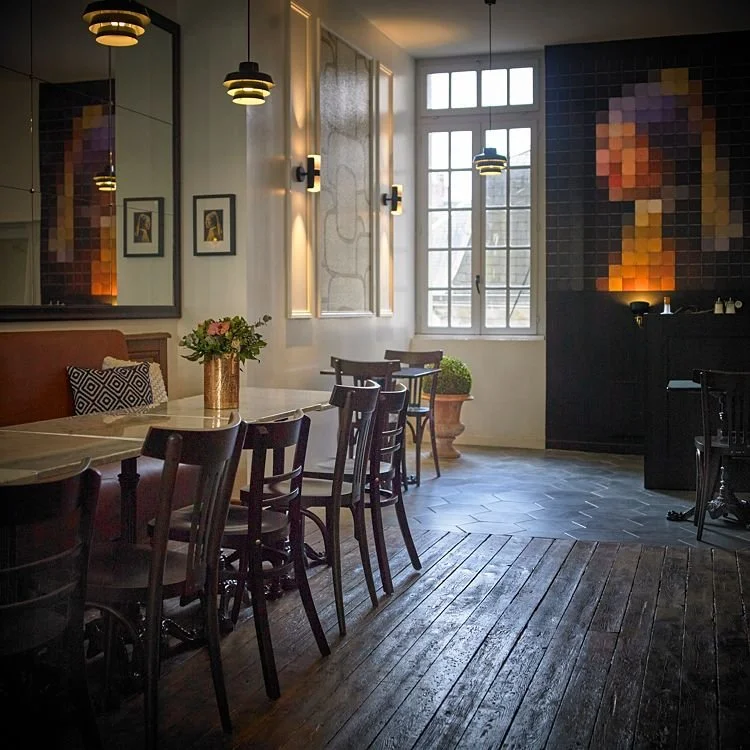
A few minutes later we found it. Le Boeuf Noisette. It is in a historic building from the eighteenth century. Its original wood flooring adding to the coziness.
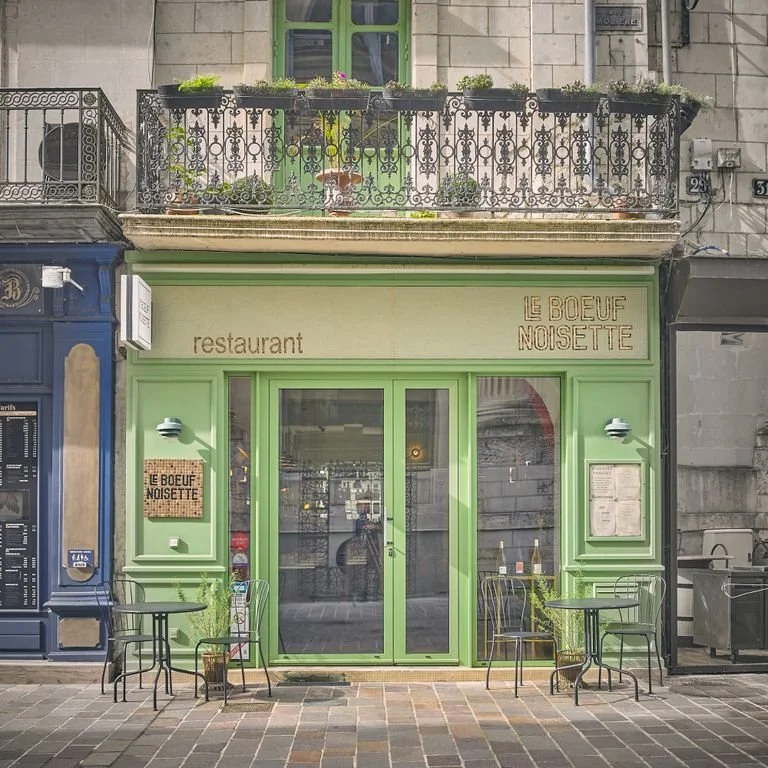
A small restaurant tucked into the town where the windows glowed with the promise of warmth and the smell of cooking drifted into the street. Inside, the room wrapped around us like a coat you didn’t realize you needed. We found a table. Sully settled in as if he had been invited personally.
A glass of wine arrived quickly, followed by the quiet rhythm of lunch service that France seems to do better than almost anywhere else. Plates appeared. Bread was broken. The conversation around us settled into that comfortable hum that only happens when people are eating well and nobody is in a hurry.
After lunch we wandered.
The streets in Saumur curve and climb gently toward the château, narrow lanes opening into small squares where cafés and bakeries lean against centuries-old stone. The pale tuffeau buildings glow softly in the Loire light, their slate roofs angled above the town.
Every few blocks the river appears again, sliding past the town exactly as it has for centuries. It’s easy to forget how much history has moved through places like this.
In June of 1940, as German forces swept across France, a group of young officer cadets from the cavalry school made a stand here during the Battle of Saumur.
More than 2,000 cadets and soldiers defended a 25-mile stretch of the Loire for two days against overwhelming German forces. They knew the outcome was inevitable, but they held the line anyway.
The town would remain occupied until August of 1944, when American forces under George S. Patton helped liberate the area. Patton himself had once trained at the Saumur cavalry school years earlier.
Saumur remembers all of this quietly.
Today the town feels peaceful.
Walk along the river and the Loire moves past without urgency. Vineyards stretch across the hills beyond town. Boats drift along the water while the château watches from above, exactly as it has for centuries.
If you decide to stay a night or two, Saumur makes it easy.
Right along the river sits the elegant Hôtel Anne d'Anjou, a historic property with views toward the château and the Loire drifting quietly past its windows.
Just outside the center, the beautiful Château de Verrières offers the full Loire Valley château experience with gardens and period interiors.
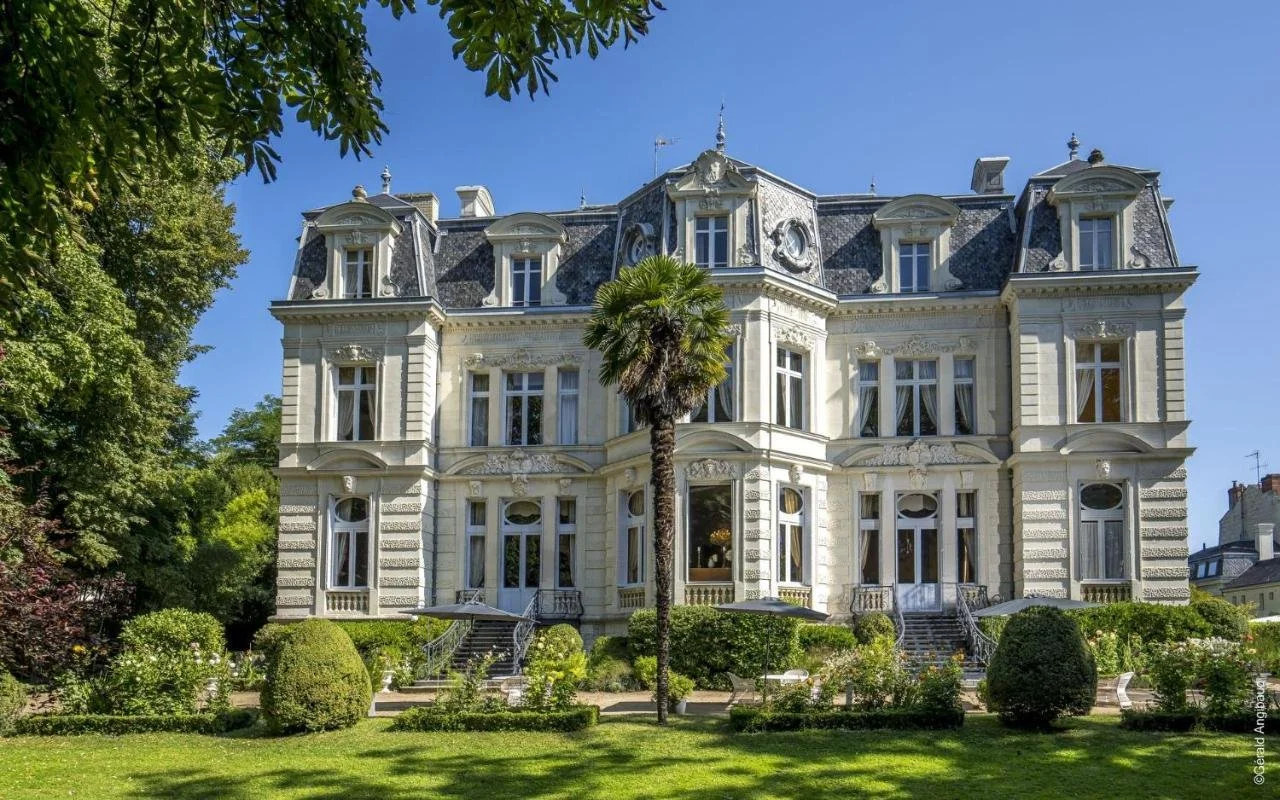
And for something uniquely local, the troglodyte hotel Logis Hôtel Demeure de la Vignole lets you sleep inside rooms carved directly into the limestone cliffs that run along the valley.
Saumur is also the kind of town where wandering into small shops becomes part of the afternoon. Wine merchants display bottles from the surrounding vineyards, antique shops quietly tempt you with objects that probably began life in nearby farmhouses, and bakeries send the smell of butter into the streets just when you think you’ve finished lunch.
If you’re trying to understand the Loire Valley, towns like Saumur are useful. They’re large enough to function, small enough to breathe, and surrounded by vineyards that seem to stretch forever. Life here moves at the pace of the river, which is to say it moves, but never in a hurry.
After a day that began in a muddy field outside a brocante market, Saumur felt like exactly the right place to end up.